How to Draw Mat Plans Geometry
If you're similar me, you probably spent a lot of time in high school memorizing the difference between sine and cosine and sighing over long, multi-step proofs, just to forget all of this hard-earned knowledge the 2nd that classes dismissed for break.
If you've forgotten a lot of your loftier schoolhouse geometry rules or are merely in need of a refresher earlier taking the GMAT, then you've institute the right article. In this article, I'll exist giving you lot a comprehensive overview of GMAT geometry.
First, I'll talk about what and how much geometry is actually on the GMAT. Side by side, I'll requite you an overview of the most important GMAT geometry formulas and rules you lot demand to know. And then, I'll show you 4 geometry sample questions and explain how to solve them. Finally, I'll talk well-nigh how to study for the geometry y'all'll encounter on the GMAT and give you tips for acing test day.
GMAT Geometry: What to Expect
If you feel like you've forgotten a lot of the geometry that you learned in high school, don't worry. The GMAT simply covers a fraction of the geometry that yous probably studied in high school. In the next section, I'll talk almost the geometry concepts that you lot'll actually find on the GMAT.
You'll find geometry concepts in both data sufficiency and trouble-solving questions. Geometry questions make upwards just nether a quarter of all questions on the GMAT quant section. As with all GMAT quant questions, you won't just demand to know how to employ geometry principles in isolation. You'll demand to know how to combine your geometry knowledge with knowledge of other concepts (like number properties, for instance) to get at the right answer. I'll talk more about what this actually means when I go over some geometry sample questions.
Not sure how or what to report? Confused by how to improve your score in the shortest time possible? Nosotros've created the only Online GMAT Prep Program that identifies your strengths and weaknesses, customizes a study plan, coaches you through lessons and quizzes, and adapts your report plan equally you better.
Nosotros believe PrepScholar GMAT is the all-time GMAT prep program bachelor, especially if you find information technology hard to organize your study schedule and don't want to spend a ton of coin on the other companies' one-size-fits-all study plans.

Equally I mentioned before, the GMAT only covers a fraction of the geometry that you learned in loftier school. Equally with the residuum of the content on the GMAT Quant section, yous'll but demand to know how to apply high school geometry concepts, which may be a relief to some exam-takers.
Unfortunately, unlike some other standardized tests (like the SAT), the GMAT doesn't provide whatsoever formulas for y'all. Yous'll have to memorize all the formulas and rules you lot'll need to know for the test.
In the next section, I'll talk to you about the almost of import rules and formulas you lot'll need to know to answer geometry problem solving and data sufficiency questions.
The Most Important GMAT Geometry Formulas and Rules to Know
The proficient news near GMAT geometry is that you don't need to brush up on a whole bunch of topics in order to do well. The bad news about GMAT geometry is that y'all'll accept to memorize all the rules and formulas you demand to know for the examination, because none will be provided to you on test twenty-four hours. You also tin't bring in any aids to help you with the exam.
In this section, I'll talk well-nigh the major GMAT geometry formulas and rules that you should report and memorize every bit you're preparing for the exam.
Lines and Angles
- A line is a 1-dimensional abstraction that goes on forever.
- For whatsoever two points, there is one straight line (just one!) that passes through them.
- A line section is a segment of a straight line that has two endpoints. The midpoint is the bespeak that divides the line segment into two equal parts.
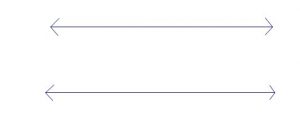
- Two lines are parallel if they lie in the same airplane and never intersect. Two lines are perpendicular if they intersect at a xc° angle.
- An angle is made when 2 lines intersect at a point. This point is called the vertex of the angle.
- Angles are measured in degrees (°).
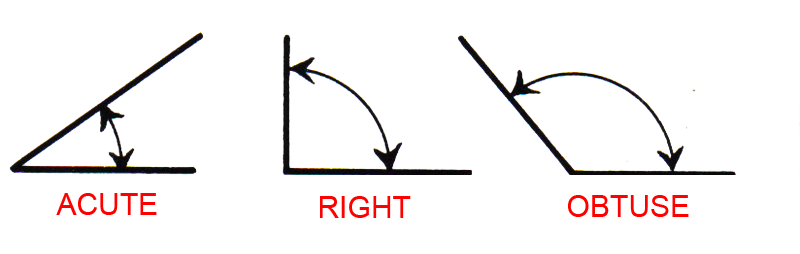
- An astute angle is an angle whose degree measure out is less so 90°.
- A right bending'southward caste measure out is exactly ninety°.
- An obtuse angle's caste measure greater than ninety°.
- A straight bending's degree measure is 180°.
- The sum of the measures of angles on a straight line is 180°.
- The sum of the measures of the angles effectually a indicate (which make a circle) is 360°.
- Two angles are supplementary if their sums make a direct angle.
- Two angles are complementary if their sums brand a right bending.
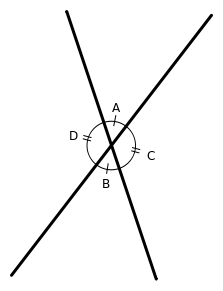
- Vertical angles are opposite angles formed by 2 intersecting line segments.
- A line or a segment bisects an angle if it splits the angle into two, smaller equal angles.
- Vertical angles are a pair of contrary angles formed by intersecting line angles. The two angles in a pair of vertical angles have the same degree measure.
Triangles
- A triangle is a closed effigy with three angles and three straight sides.
- The sum of the interior angles of a triangle is 180°.
- Each interior angle is supplementary to an adjacent exterior angle. Together, they equal 180°.
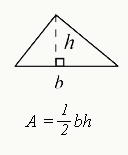
- The formula for finding the area of a triangle is $½bh$.
- $b$ = base of operations
- $h$ = height
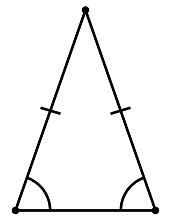
- An isosceles triangle has ii sides of equal length.
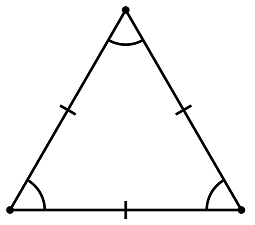
- An equilateral triangle has 3 equal sides and three angles of 60°.
- There are two kinds of special right triangles:
- Isosceles right triangles have a side relationship of 1:i:$√2$.
- 30°60°90° triangles take a side relationship of 1:$√3$:2.
- A correct triangle has one 90° interior angle. The side opposite the right angle is called the hypotenuse and it's the longest side of the triangle.
- Pythagorean Theorem for finding side lengths of a right triangle: $a^two + b^2 = c^ii$
- Two triangles are similar if their respective angles have the same degree measure.
- Two triangles are coinciding if respective angles have the same measure and corresponding sides have the same length.
Circles
- The diameter of a circle is a line segment that connects ii points on the circle and passes through the center of the circle.
- The radius is a line segment from the center of the circle to whatever betoken on it.
- A circumvolve's central angle is formed by two radii.
- The distance effectually the circumvolve is chosen circumference:
- $C=πd$
- $C = 2πr$
- An arc is a part of the circumference of a circle.
- $\Length = (northward/360°)C$, where $n$ is the measurement of the primal angle of the circle portion in degrees.
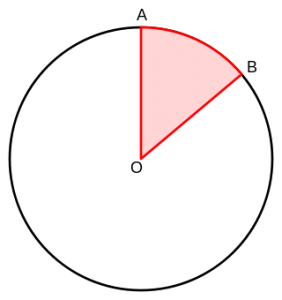
- The expanse of a circle is found with the formula $A = πr^2$.
Polygons
- A polygon is a closed figure that has straight line segments every bit its sides.
- The perimeter of a polygon is the altitude around the polygon (the sum of the length of all its sides).
- The sum of the four interior angles of a quadrilateral is 360°.
- Area of a foursquare: $s^2$
- Area of a rectangle: $l$$w$
- Surface area of a parallelogram: $b$$h$
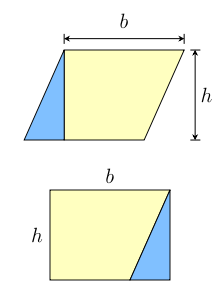
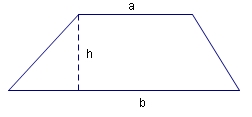
- Area of a trapezoid: $1/two(a + b)h$
Solids
- A cylinder is a solid whose horizontal cross section is a circumvolve.
- Volume of a cylinder: $Bh$, where $B$ is the area of the base.
- Area of the base of a cylinder: ?rii (because, retrieve, a cylinder has a circular cantankerous section)
- A cube is a rectangular solid where all the faces are squares.
- Volume of a cube: $Bh$, where $B$ is the area of the base.
- A rectangular solid is a solid with six rectangular faces.
- Volume of a rectangular solid: $lwh$
Coordinate Geometry
- The slope of a line tells you lot how steeply that line goes up or downwardly the coordinate aeroplane.
- $slope$ = $rise$/$run$
- $slope = alter in $y$ / alter in $x$
- The ascent is the difference between the $y$-coordinate values of two points on the line; the run is the difference betwixt the x-coordinate values of two points on the line.
- You tin likewise observe the gradient of a line using the gradient-intercept equation, which is $y = mx + b$, where the gradient is $g$ and the $b$ is the value of the $y$-intercept.
- Perpendicular lines have slopes that are negative reciprocals of one another.
- To make up one's mind the distance between any two points on a coordinate airplane, you can use the Pythagorean theorem.
4 Tips for GMAT Geometry Questions
Even the most prepared test-takers can feel a lot of anxiety on examination day. Follow these tips to boost your score and assist you work your fashion through tricky GMAT geometry questions.
#i: Use What You lot Know
For all GMAT geometry questions, start by identifying what you know and what you need to find out. Employ the information in the question and in whatsoever diagrams to build upward your understanding of a figure. For instance, if y'all know that the measure of two different angles in a triangle are sixty degrees and 80 degrees, respectively, you can use what you know to effigy out the measure of the third angle. The more information you have, the more you'll be able to figure out.
#2: Look for Connections on Multiple Figure Questions
If in that location is more one recognizable shape in a diagram, at that place is a connexion between them. Look for what i of the figures tells you lot about the other. Perhaps the diagonal of a square is the same every bit the radius of a circle. Or the height of 1 triangle is the hypotenuse of another. Whatever the connexion, it'southward probably the key to answering the question.
#3: Don't Presume That Drawings Are To Scale
You can't assume that diagrams on the GMAT are to-scale. If you're assuming a shape is a square and information technology'south really a rectangle, you can make big mistakes in your calculations. Just employ the information given to you on the diagram or in the question itself. Don't ever presume annihilation that you can't reason out with common cold, hard math.
#4: Make Your Ain Diagram
If you're solving a question that involves a shape, but the test doesn't give you a diagram, make your ain. Making your own diagram will help you better visualize a question. You can too re-draw a diagram on your flake newspaper fifty-fifty if the exam provides yous with a diagram to view. Sometimes, re-cartoon a diagram will assist you become a better agreement of the figure and then that you can more hands solve the trouble.
GMAT Geometry Exercise Questions
One of the nearly important parts of preparing for the GMAT is to do solving real GMAT questions. Solving existent GMAT geometry questions helps yous prepare for the content that you lot'll really run into on the test. In this department, I'll walk you through four existent GMAT sample questions that utilize geometry concepts: two problem-solving questions and two information sufficiency questions.
Trouble Solving Sample Question 1
A rectangular floor that measures viii meters past 10 meters is to be covered with carpet squares that each measure 2 meters by 2 meters. If the carpet squares cost $12 apiece, what is the total cost for the number of carpet squares needed to cover the floor?
- $200
- $240
- $480
- $960
- $1920
To start, since this trouble doesn't provide a diagram, we want to depict our own on fleck paper. Drawing your own diagram helps you ameliorate visualize the problem. And so, draw a rectangle and label the sides "eight m" and "10 m," since nosotros know that from the problem.
Next, let's have a step back and think about what the question is asking us. Information technology'southward request to figure out the cost of covering a floor in carpet squares. When you're covering a flooring in carpet squares, you want to cover the unabridged area of the floor. So, our next pace is to find the area.
We know that the formula for area of a rectangle is $a = lw$. Allow's solve that using the information nosotros have. $A = (viii)(10)$. The area of this rectangle is 80 $g^ii$.
Now, we need to figure out how much area each rug square covers. The formula for finding the expanse of a square is likewise $lw$, so let'due south become ahead and practise that. $Area = (2m)(2m)$. The surface area covered by each carpet foursquare is four$m^2$.
To find the number of carpet squares needed to cover the flooring, we'll separate the full area of the floor by the expanse of each individual carpet square. $lxxx 1000^ii/ iv g^2 = xx$ total rug squares needed to cover the floor.
Want to Identify YOUR GMAT Strengths and Weaknesses?
Our proprietary GMAT Diagnostic Assessment creates a customized report program for y'all that takes you from registration all the way to test solar day! It is included with every account and proven to significantly maximize your score.
Get your personalized assessment as part of your v 24-hour interval risk-free trial now:

The cost of each carpet square is 12, so for our final step, nosotros'll multiply 20 (number of carpet squares needed) by 12 (cost per carpet square) to go a full of $240.
The correct reply is B.
Problem Solving Sample Question 2
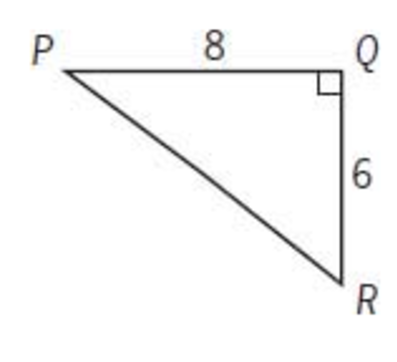 The figure above shows a path around a triangular slice of land. Mary walked the distance of 8 miles from $P$ to $Q$ and and then walked the distance of 6 miles from $Q$ to $R$. If Ted walked straight from $P$ to $R$, by what percent did the distance that Mary walked exceed the distance that Ted walked?
- 30%
- 40%
- 50%
- 60%
- 80%
As e'er, let'southward commencement by figuring out what this question'south asking us. Information technology's request us to compare the distance Mary walked to the distance Ted walked. In order to do that, we demand to first figure out how far they really walked.
It's pretty easy to figure out how far Mary walked. We tin can but add 8 + 6. Mary walked 14 miles.
Information technology'south a little trickier to figure out how far Ted walked. Discover that the diagram is in the shape of a right triangle. That tells the states that we can utilise the Pythagorean theorem to discover the length of Ted's walk, which is really simply the missing side of this triangle. Since Ted'south side is across from the right angle, nosotros know that it's the hypotenuse. Therefore, we can plug in our sides pretty easily. $8^2$+$6^2$ = $PR^two$ or $64$ + $36$ = $PR^two$, or $100 = $PR^2$. We can then discover the square root of 100, which is 10. So, $PR = 10mi$.
At present, nosotros know that Mary walked 14 miles and Ted walked 10 miles. Therefore, the distance Mary walked exceeded the altitude Ted walked by 4 miles ($14 – 10 = 4$). 4 is 40% of ten, so the correct reply is B. Mary exceeded the distance Ted walked past 40%.
Information Sufficiency Sample Question 1
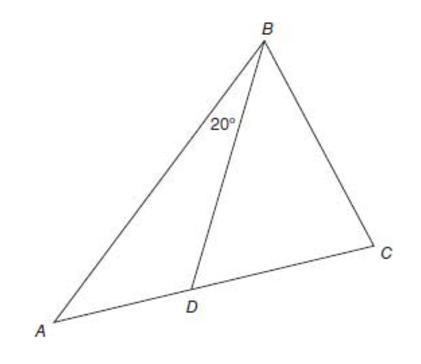 In the figure to a higher place, point D is on Ac. What is the degree measure of $\bending ∠ {BAC}$?
- The measure out of BDC is lx°.
- The degree measure out of BAC is less than the degree measure out of $\angle ∠ {BCD}$.
- Statement (1) Alone is sufficient, but statement (2) alone is non sufficient.
- Statement (ii) Solitary is sufficient, but statement (1) alone is non sufficient.
- BOTH statements TOGETHER are sufficient, but NEITHER statement ALONE is sufficient.
- EACH statement Lone is sufficient.
- Statements (1) and (two) TOGETHER are Not sufficient.
This question's asking united states of america to determine measure of an interior angle of a triangle. For data sufficiency questions, we always want to accost each statement separately FIRST. Let's begin with statement (1).
Argument (1) states that angle BDC measures sixty degrees. Since nosotros know that $\bending ∠ {BDC}$ is on a straight line, we know that the angle adjacent to it ($\bending ∠ {BDA}$) can be added to $\angle ∠ {BDC}$to equal 180°. So, we can discover the measure of bending BDA by using the equation: $180 – 60$ = $\angle ∠ {BDA}$. Therefore, we know the measure of $\angle ∠ {BDA}$ is 120°.
Next, nosotros know that all the angles inside a triangle add upwardly to 180°. Since we now know the measure of angle BDA (120) and the measure of $\angle ∠ {ABD}$ (20), we can find the third angle in that triangle by using the equation 180 – (xx + 120) = $\bending ∠ {BAC}$. So, argument (i) is sufficient. We now can eliminate answer B and answer E.
Now, let's move on to statement (2). We want to forget everything we know about statement (one) at offset and address statement (2) by itself.
The argument tells us that the degree mensurate of $\angle ∠ {BAC}$ is less than the caste mensurate of $\angle ∠ {BCD}$. However, we don't have plenty data to effigy out what the measure of either bending actually is. So, argument (two) is not sufficient.
The correct respond then is A; statement (1) solitary is sufficient.
Data Sufficiency Sample Question 2
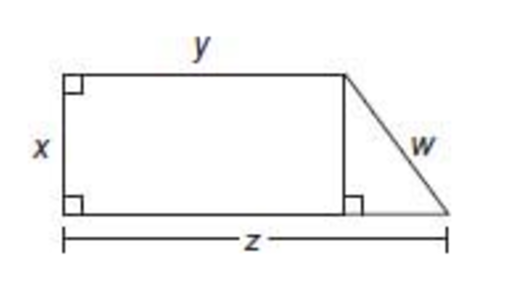 In the figure above, what is the value of $z$?
- $x = y = 1$
- $w = 2$
- Argument (one) Lonely is sufficient, but statement (ii) alone is not sufficient.
- Argument (2) ALONE is sufficient, merely statement (1) solitary is not sufficient.
- BOTH statements TOGETHER are sufficient, but NEITHER statement Lone is sufficient.
- EACH statement ALONE is sufficient.
- Statements (ane) and (two) TOGETHER are Non sufficient.
Remember, when solving data sufficiency questions, yous desire to take each statement past itself start. Also go on in mind that you tin't assume that whatsoever diagrams given are to calibration. You might be tempted to say that the triangle pictured is an isosceles right triangle, merely you tin can't presume that. Keeping all this in mind, let's look at statement (1).
Statement (1) says that $ten = y = 1$. That means that both $x$ and $y$ = i. Can we use that to notice the value of z?
Well, nosotros know that the value of z is equal to i + the value of the base of the right triangle. At that place's no information in the trouble to tell us what the value of the base of operations of the right triangle is. So, the value of the base tin vary, so the value of $z$ can vary.
That ways that statement (one) isn't sufficient past itself.
At present, allow'south look at statement (2) by itself first. Statement (2) says $westward = two$. However, even though we know that $westward = two$, we don't know anything nearly the rest of the sides. That means all the other sides can vary, then z tin can vary too. Statement (2) isn't sufficient past itself either.
Now, let's look at the two statements together.
Taking (1) and (2) together, we know that $z = y + (z – y)$ [the base of the triangle]. Or, nosotros can say that $z = 1y + (z – i)$.
The value of $z – one$ can be determined past applying the Pythagorean theorem to the triangle. We know that the hypotenuse is two (from statement (2): $w = 2$) and we know that one side = 1 (from $x = 1$) and 1 side equals $z – one$.
Nosotros can then write the equation $1^ii + (z – 1)^2 = 2^2$. Since we only accept ane variable in the equation, we can solve through for z.
You lot don't need to solve a data sufficiency question. You only need to know that you lot tin! Then since we know we tin can solve the question using both statements, the right respond is C. Both statements together are sufficient.

How to Study for Geometry on the GMAT
Studying for the GMAT may seem overwhelming, because there'due south a lot of content to review. The good news is that executing a well-thought-out study programme volition help you reach your goals. Hither are some tips geometry for the GMAT.
#1: Use Loftier Quality Practice Materials
The best manner to prepare for the GMAT is by using existent GMAT geometry questions in your prep. Real GMAT geometry questions will simulate the GMAT's way and content. For instance, you'll have to employ more than ane skill in the question, or you'll get practice using your geometry skills on data sufficiency questions, which are unique to the GMAT. Using resources like GMATPrep or the GMAT Official Guide will give you access to real, retired GMAT questions.
As you might've noticed from our practice questions, yous'll rarely run across a straightforward question on the GMAT that only asks you to utilize your geometry skills. You'll likely have to combine your knowledge of geometry with your knowledge of arithmetic or number backdrop or ratios… or all of the above! Practicing GMAT-mode questions (existent, retired GMAT questions if you can go them) will give you do at using multiple skills in one question.
#2: Memorize Important Formulas
Every bit I mentioned before, y'all won't get to employ a formula cheat sheet on the GMAT. You'll have memorize all the formulas you await to need on test day. Using flashcards is a swell way to build your knowledge and so that you tin can quickly recall and use important formulas on test day.
What's Next?
You've read all most the formulas you lot need to know for GMAT geometry. Are you ready to chief them? Using flashcards can be a bully fashion to heave your memory. Before y'all get started with flashcards, check out our full guide to GMAT flashcards to learn about the best GMAT flashcards out in that location and the best mode to study with flashcards.
Feel similar y'all've mastered GMAT geometry? Looking for a new challenge on your quest to total GMAT quant domination? Cheque out our guide to GMAT probability to conquer a new type of math of the GMAT.
Are yous totally confused past the data sufficiency practise questions? If so, don't worry. Data sufficiency questions may seem foreign, but our total guide to data sufficiency on the GMAT will break down everything you lot need to know to main this question type.
Was this helpful? Sign up for FREE GMAT and MBA guides!
Source: https://www.prepscholar.com/gmat/blog/gmat-geometry-questions-formulas/
0 Response to "How to Draw Mat Plans Geometry"
Post a Comment