How Do You Know if Something Satifies the Octet Rule
Violations of the Octet Dominion
- Page ID
- 1994
Iii cases tin can exist constructed that do non follow the Octet Rule, and as such, they are known as the exceptions to the Octet Rule. Post-obit the Octet Dominion for Lewis Dot Structures leads to the most accurate depictions of stable molecular and atomic structures and because of this we always want to utilize the octet rule when cartoon Lewis Dot Structures. However, it is hard to imagine that one dominion could be followed past all molecules. There is ever an exception, and in this instance, three exceptions. The Octet Rule is violated in these three scenarios:
- When at that place are an odd number of valence electrons
- When there are also few valence electrons
- When there are likewise many valence electrons
Reminder: Always employ the Octet Dominion when drawing Lewis Dot Structures, these exceptions will only occur when necessary.
Exception 1: Species with Odd Numbers of Electrons
The first exception to the Octet Rule is when in that location are an odd number of valence electrons. An case of this would be the nitrogen (Ii) oxide molecule (\(NO\)). Nitrogen atom has 5 valence electrons while the oxygen atom has vi electrons. The total would be 11 valence electrons to exist used. The Octet Rule for this molecule is fulfilled in the to a higher place example, however that is with 10 valence electrons. The final 1 does not know where to get. The lonely electron is chosen an unpaired electron. But where should the unpaired electron go? The unpaired electron is normally placed in the Lewis Dot Structure and so that each chemical element in the structure will accept the lowest formal charge possible. The formal charge is the perceived charge on an individual atom in a molecule when atoms do not contribute equal numbers of electrons to the bonds they participate in. The formula to notice a formal charge is:
Formal Charge= [# of valence east- the atom would have on its own] - [# of lone pair electrons on that cantlet] - [# of bonds that cantlet participates in]
No formal charge at all is the most ideal situation. An case of a stable molecule with an odd number of valence electrons would be nitrogen monoxide. Nitrogen monoxide has 11 valence electrons (Effigy one). If you need more information nearly formal charges, see Lewis Structures. If we were to consider the nitrogen monoxide cation (\(NO^+\) with ten valence electrons, then the following Lewis structure would be constructed:
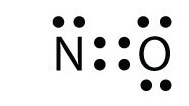
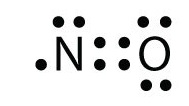
Nitrogen usually has five valence electrons. In Figure 1, information technology has two solitary pair electrons and it participates in two bonds (a double bond) with oxygen. This results in nitrogen having a formal charge of +one. Oxygen commonly has six valence electrons. In Figure 1, oxygen has four lone pair electrons and information technology participates in 2 bonds with nitrogen. Oxygen therefore has a formal charge of 0. The overall molecule here has a formal charge of +1 (+ane for nitrogen, 0 for oxygen. +1 + 0 = +one). However, if we add the eleventh electron to nitrogen (because we desire the molecule to accept the lowest total formal accuse), information technology volition bring both the nitrogen and the molecule's overall charges to nix, the most platonic formal charge state of affairs. That is exactly what is done to go the correct Lewis construction for nitrogen monoxide:
Free Radicals
There are really very few stable molecules with odd numbers of electrons that exist, since that unpaired electron is willing to react with other unpaired electrons. Most odd electron species are highly reactive, which nosotros call Free Radicals. Because of their instability, gratis radicals bond to atoms in which they can take an electron from in order to become stable, making them very chemically reactive. Radicals are found as both reactants and products, simply generally react to form more stable molecules as shortly every bit they tin. To emphasize the being of the unpaired electron, radicals are denoted with a dot in front of their chemic symbol as with \({\cdot}OH\), the hydroxyl radical. An case of a radical you may by familiar with already is the gaseous chlorine cantlet, denoted \({\cdot}Cl\). Interestingly, molecules with an odd number of Valence electrons volition always be paramagnetic.
Exception 2: Incomplete Octets
The second exception to the Octet Rule is when there are too few valence electrons that results in an incomplete Octet. There are even more occasions where the octet rule does not give the most correct depiction of a molecule or ion. This is also the example with incomplete octets. Species with incomplete octets are pretty rare and more often than not are only constitute in some glucinium, aluminum, and boron compounds including the boron hydrides. Let's take a look at one such hydride, \(BH_3\) (Borane).
If one was to make a Lewis structure for \(BH_3\) following the basic strategies for drawing Lewis structures, one would probably come upwards with this structure (Figure 3):
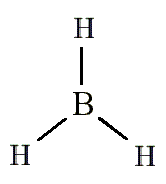
The problem with this structure is that boron has an incomplete octet; it only has six electrons around information technology. Hydrogen atoms can naturally simply accept merely 2 electrons in their outermost shell (their version of an octet), and as such there are no spare electrons to form a double bond with boron. 1 might surmise that the failure of this structure to form consummate octets must mean that this bond should exist ionic instead of covalent. Yet, boron has an electronegativity that is very similar to hydrogen, meaning there is probable very little ionic character in the hydrogen to boron bonds, and as such this Lewis structure, though it does not fulfill the octet dominion, is likely the best structure possible for depicting BHthree with Lewis theory. 1 of the things that may account for BH3's incomplete octet is that it is normally a transitory species, formed temporarily in reactions that involve multiple steps.
Permit's have a await at another incomplete octet situation dealing with boron, BF3 (Boron trifluorine). Like with BH3, the initial drawing of a Lewis structure of BF3 volition form a structure where boron has only half dozen electrons around it (Figure 4).
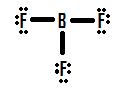
If you look Effigy 4, y'all can see that the fluorine atoms possess extra lone pairs that they can utilise to make boosted bonds with boron, and you might think that all you take to do is make ane lonely pair into a bond and the structure volition be right. If nosotros add one double bond between boron and i of the fluorines we go the following Lewis Structure (Figure v):
Each fluorine has viii electrons, and the boron atom has viii as well! Each cantlet has a perfect octet, right? Non so fast. We must examine the formal charges of this construction. The fluorine that shares a double bond with boron has six electrons around information technology (iv from its two lone pairs of electrons and one each from its ii bonds with boron). This is one less electron than the number of valence electrons information technology would have naturally (Group seven elements have 7 valence electrons), so it has a formal charge of +one. The 2 flourines that share single bonds with boron have seven electrons around them (six from their three solitary pairs and one from their single bonds with boron). This is the same amount as the number of valence electrons they would have on their own, so they both take a formal accuse of zero. Finally, boron has four electrons around it (i from each of its four bonds shared with fluorine). This is one more electron than the number of valence electrons that boron would take on its own, and as such boron has a formal accuse of -i.
This structure is supported by the fact that the experimentally determined bail length of the boron to fluorine bonds in BFthree is less than what would exist typical for a unmarried bond (run into Bond Social club and Lengths). However, this structure contradicts one of the major rules of formal charges: Negative formal charges are supposed to be found on the more electronegative cantlet(s) in a bail, only in the construction depicted in Figure 5, a positive formal accuse is establish on fluorine, which not only is the almost electronegative element in the structure, only the most electronegative chemical element in the entire periodic table (\(\chi=4.0\)). Boron on the other hand, with the much lower electronegativity of 2.0, has the negative formal charge in this structure. This formal charge-electronegativity disagreement makes this double-bonded structure impossible.
However the big electronegativity difference here, as opposed to in BHiii, signifies significant polar bonds between boron and fluorine, which means there is a high ionic grapheme to this molecule. This suggests the possibility of a semi-ionic construction such as seen in Figure half-dozen:

None of these three structures is the "correct" construction in this instance. The most "correct" construction is most likely a resonance of all three structures: the one with the incomplete octet (Effigy 4), the one with the double bail (Figure 5), and the ane with the ionic bond (Effigy six). The almost contributing structure is probably the incomplete octet structure (due to Figure 5 existence basically impossible and Effigy six not matching upwards with the behavior and properties of BF3). As y'all can see even when other possibilities exist, incomplete octets may all-time portray a molecular structure.
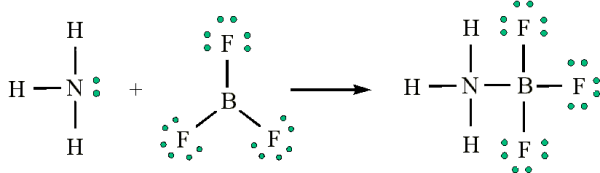
Every bit a side notation, it is important to note that BFthree ofttimes bonds with a F- ion in order to grade BFfour - rather than staying as BF3. This structure completes boron'southward octet and it is more common in nature. This exemplifies the fact that incomplete octets are rare, and other configurations are typically more favorable, including bonding with additional ions equally in the case of BFiii .
Example: \(BF_3\)
Draw the Lewis construction for boron trifluoride (BFthree).
Solution
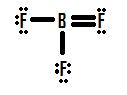
ane. Add electrons (3*7) + 3 = 24
2. Describe connectivities:
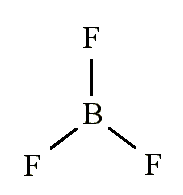
iii. Add octets to outer atoms:
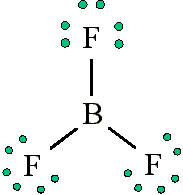
4. Add together extra electrons (24-24=0) to central cantlet:
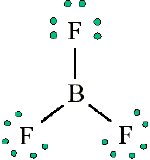
5. Does central electron accept octet?
- NO. It has vi electrons
- Add a multiple bond (double bail) to see if central atom tin achieve an octet:
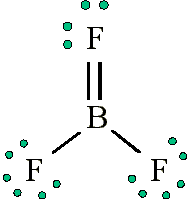
6. The central Boron now has an octet (there would be three resonance Lewis structures)
However...
- In this construction with a double bond the fluorine atom is sharing extra electrons with the boron.
- The fluorine would have a '+' fractional accuse, and the boron a '-' partial charge, this is inconsistent with the electronegativities of fluorine and boron.
- Thus, the structure of BFiii, with single bonds, and 6 valence electrons around the central boron is the well-nigh probable structure
- BF3 reacts strongly with compounds which take an unshared pair of electrons which tin can be used to form a bond with the boron:
Exception 3: Expanded Valence Shells
More mutual than incomplete octets are expanded octets where the central atom in a Lewis structure has more than eight electrons in its valence shell. In expanded octets, the central atom can accept ten electrons, or fifty-fifty twelve. Molecules with expanded octets involve highly electronegative last atoms, and a nonmetal central atom constitute in the 3rd menses or below, which those last atoms bail to. For case, \(PCl_5\) is a legitimate chemical compound (whereas \(NCl_5\)) is not:
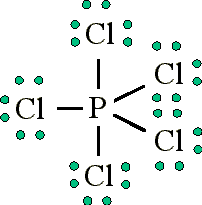
Expanded valence shells are observed only for elements in period 3 (i.e. n=three) and beyond
The 'octet' rule is based upon available nsouthward and np orbitals for valence electrons (two electrons in the southward orbitals, and six in the p orbitals). Outset with the due north=3 principle quantum number, the d orbitals become available (l=2). The orbital diagram for the valence shell of phosphorous is:

Hence, the third period elements occasionally exceed the octet rule by using their empty d orbitals to accommodate boosted electrons. Size is too an important consideration:
- The larger the central atom, the larger the number of electrons which tin surroundings information technology
- Expanded valence shells occur most oftentimes when the central atom is bonded to small electronegative atoms, such every bit F, Cl and O.
There is currently much scientific exploration and enquiry into the reason why expanded valence shells are found. The summit surface area of interest is figuring out where the extra pair(s) of electrons are found. Many chemists remember that in that location is not a very large energy difference between the 3p and 3d orbitals, and as such information technology is plausible for extra electrons to hands fill the 3d orbital when an expanded octet is more favorable than having a consummate octet. This matter is still under hot debate, notwithstanding and there is even debate as to what makes an expanded octet more favorable than a configuration that follows the octet rule.
One of the situations where expanded octet structures are treated as more favorable than Lewis structures that follow the octet dominion is when the formal charges in the expanded octet structure are smaller than in a structure that adheres to the octet rule, or when in that location are less formal charges in the expanded octet than in the structure a structure that adheres to the octet rule.
Example two: The \(SO_4^{-2}\) ion
The sulfate ion, And thenfour -2. is an ion that prefers an expanded octet structure. A strict adherence to the octet rule forms the post-obit Lewis structure:

If nosotros expect at the formal charges on this molecule, we tin can encounter that all of the oxygen atoms have 7 electrons effectually them (half dozen from the three lone pairs and one from the bail with sulfur). This is one more electron than the number of valence electrons then they would accept normally, and as such each of the oxygen atoms in this construction has a formal charge of -1. Sulfur has four electrons around it in this construction (ane from each of its 4 bonds) which is ii electrons fewer than the number of valence electrons it would have normally, and as such it carries a formal charge of +2.
If instead nosotros fabricated a construction for the sulfate ion with an expanded octet, it would look like this:

Looking at the formal charges for this structure, the sulfur ion has half-dozen electrons around it (one from each of its bonds). This is the same amount equally the number of valence electrons it would have naturally. This leaves sulfur with a formal charge of zilch. The two oxygens that accept double bonds to sulfur have half dozen electrons each around them (four from the two lone pairs and one each from the two bonds with sulfur). This is the same corporeality of electrons as the number of valence electrons that oxygen atoms accept on their own, and equally such both of these oxygen atoms take a formal charge of cipher. The two oxygens with the unmarried bonds to sulfur accept 7 electrons effectually them in this structure (six from the 3 lonely pairs and one from the bond to sulfur). That is ane electron more than the number of valence electrons that oxygen would have on its own, and as such those ii oxygens behave a formal charge of -i. Remember that with formal charges, the goal is to keep the formal charges (or the departure between the formal charges of each atom) as pocket-sized as possible. The number of and values of the formal charges on this structure (-1 and 0 (difference of 1) in Figure 12, as opposed to +2 and -1 (difference of 3) in Figure 12) is significantly lower than on the structure that follows the octet rule, and every bit such an expanded octet is plausible, and even preferred to a normal octet, in this example.
Instance 3: The \(ICl_4^-\) Ion
Draw the Lewis structure for \(ICl_4^-\) ion.
Solution
i. Count up the valence electrons: 7+(4*seven)+1 = 36 electrons
2. Draw the connectivities:
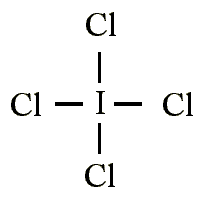
iii. Add octet of electrons to outer atoms:
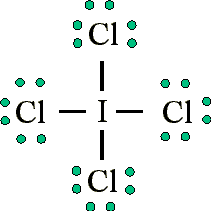
iv. Add extra electrons (36-32=4) to central cantlet:
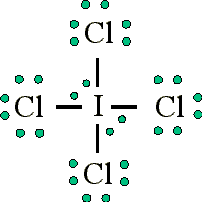
five. The ICliv - ion thus has 12 valence electrons around the fundamental Iodine (in the 5d orbitals)
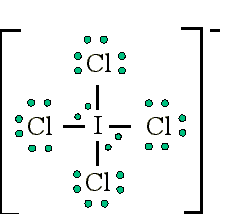
Expanded Lewis structures are likewise plausible depictions of molecules when experimentally determined bond lengths advise partial double bail characters even when single bonds would already fully fill the octet of the central cantlet. Despite the cases for expanded octets, every bit mentioned for incomplete octets, it is important to keep in mind that, in general, the octet rule applies.
Exercise Issues
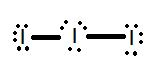
- Draw the Lewis construction for the molecule I3 -.
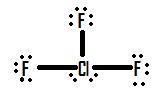
- Draw the molecule ClF3.
- The central atom for an expanded octet must accept an diminutive number larger than what?
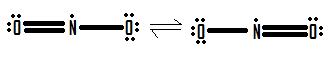
- Draw the Lewis structure for the molecule NOii .
- Which Lewis structure is more than likely?
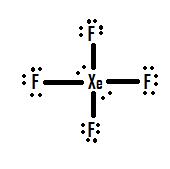 or
or 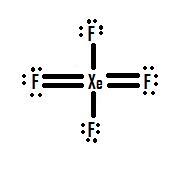
Answers
1. 
2. 
three. 10 (Sodium and higher)
4. 
v.
References
- Petrucci, Ralph H.; Harwood, William S.; Herring, F. 1000.; Madura, Jeffrey D. General Chemical science: Principles & Modern Applications . 9th Ed. New Jersey. Pearson Education, Inc. 2007.
- Moore, John W.; Stanitski, Conrad L. ; Jurs, Peter C. Chemistry; The Molecular Scientific discipline . 2d Ed. 2004.
Source: https://chem.libretexts.org/Bookshelves/Physical_and_Theoretical_Chemistry_Textbook_Maps/Supplemental_Modules_(Physical_and_Theoretical_Chemistry)/Chemical_Bonding/Lewis_Theory_of_Bonding/Violations_of_the_Octet_Rule
0 Response to "How Do You Know if Something Satifies the Octet Rule"
Post a Comment